
Beyond Prompting: Spec-Driven and Harness Engineering for LLMs

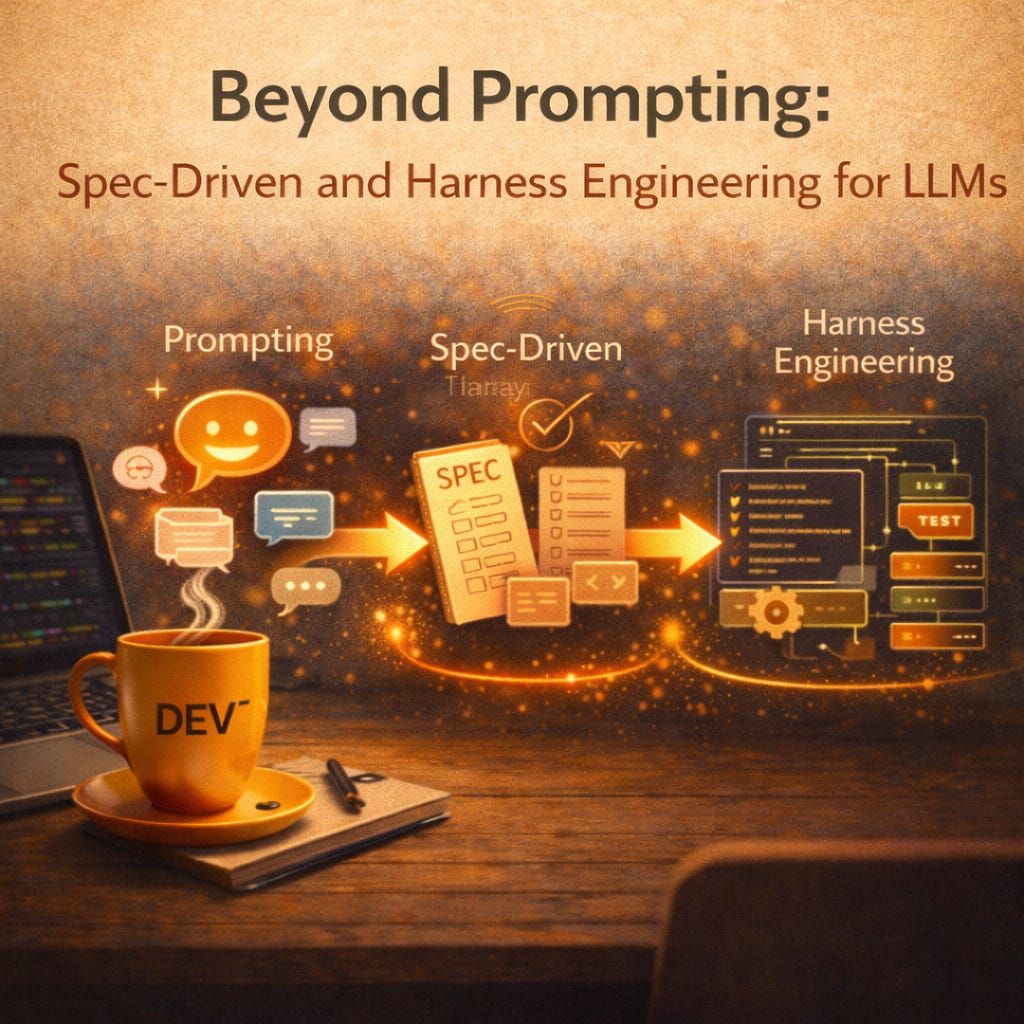
Most developers start using AI with simple prompts, and that works… until it doesn’t.
As soon as you need consistency, quality, and reliability, “just prompting” is not enough. You need structure, clear intent, and validation, just like in backend engineering.
That’s why prompt engineering is evolving into something bigger: a progression from quick experiments to well-designed, production-ready systems.
🧠 The 4 Levels of Prompt Engineering
1. Ad-hoc Prompting (Beginner)
You just ask the model and see what happens.
✔️ Fast
❌ Inconsistent
👉 Good for exploration, not for real systems.
2. Structured Prompting (Intermediate)
You start adding:
Roles
Examples
Constraints
Prompts become reusable.
✔️ More reliable
✔️ Repeatable
❌ Still manual
3. System Prompting (Advanced)
Now prompts are part of a system:
Templates
Tools
Guardrails
👉 This is where prompting becomes engineering.
4. Spec-Driven Prompting (Expert)
You define a specification first, then generate prompts from it.
Spec = intent
Prompt = execution
👉 This aligns with how we design good APIs: contract first, implementation later.
⚙️ The 3 Paradigms You Should Know
1. Vibe Coding (Exploration-first)
You describe what you want, and the AI figures it out.
✔️ Very fast
❌ Unpredictable
👉 Great for prototypes, risky for production.
2. Spec-Driven Development (Intent-first)
You define:
Inputs
Outputs
Rules
Edge cases
✔️ Clear and consistent
❌ Requires discipline
👉 Similar to designing a clean service contract in microservices.
3. Harness Engineering (System-first)
You build a system around the model:
Tests
Evaluations
Feedback loops
Retries
👉 Core idea: Don’t trust the model, validate it.
✔️ Production-ready
✔️ Measurable quality
❌ More complex
Conclusion
You start with Vibe to explore ideas fast.
Then move to Spec to bring clarity and structure.
And finally, use Harness to guarantee quality and reliability.
If you build Java backends, this flow should feel natural:
You experiment
You define contracts
You add tests and validation
👉 Prompt engineering follows the same path.
Treat it like software engineering, with clear intent, good design, and strong feedback loops, and you’ll build AI systems that are not just impressive, but reliable and production-ready.